
Physics A Level | Chapter 2: Accelerated motion 2.6 Measuring velocity and acceleration
In a car crash, the occupants of the car may undergo a very rapid deceleration. This can cause them serious injury, but can be avoided if an air-bag is inflated within a fraction of a second. Figure 2.7 shows the tiny accelerometer at the heart of the system, which detects large accelerations and decelerations.
The acceleration sensor consists of two rows of interlocking teeth. In the event of a crash, these move relative to one another, and this generates a voltage that triggers the release of the air-bag.
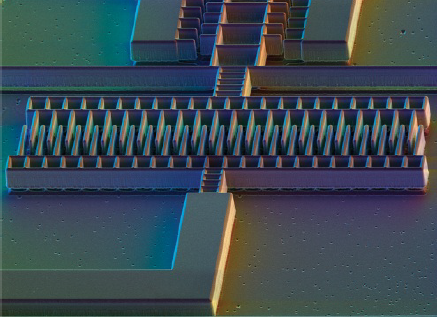
decelerations as a vehicle travels along the road. This electron microscope image shows the device
magnified about 1000 times
At the top of the photograph (Figure 2.7), you can see a second sensor that detects sideways accelerations. This is important in the case of a side impact.
These sensors can also be used to detect when a car swerves or skids, perhaps on an icy road. In this case, they activate the car’s stability-control systems.